Well I have spent a few days "finishing off" the last few items on my Y class. Sound is fitted (Tsunami Baldwin VO), lights wired and people in the cab. Runs and sounds great, perhaps needs a little more weight but it loooks the part. I still need to fit the numberplates when I eventually get them.
Although I had finished the XA some time ago, its still needed some detail. After fitting the sound chip (Tsunami Fairbanks Morse) and speaker, I added the crew, the pull down blinds in the front, made some window wipers for the windscreen, added the handrails and steps. I also fitted the fan cover (made from a tap aerator) inside the lip on the roof to make it flush with the body.
Im very happy with the end result.
Tuesday, August 28, 2012
Monday, July 30, 2012
Watheroo Engine Shed
Watheroo on the Midland
Railway of WA
Watheroo is a small town and railway location on the Midland
Railway line, 185 kms (123 miles) from Midland, or almost halfway between
Midland and Walkaway. The MR was a privately owned railway before it was
absorbed by the WAGR in 1964.
In earlier days Watheroo station yard would have seen quite a lot of
activity. Apart from the 300 ft platform and brick station buildings, the yard
also boasted a coaling tower, water tank, turntable (later replaced with a
triangle) and a loading ramp and crane. There was also a substantial wheat bin. The station
and station buildings and engine shed, built in 1941, still stand in the
railway yard. The Engine shed is used for storage and for unloading road vehicles while the station building currently serves as a tavern.
The engine shed, which was the second to have occupied the
site is a distinctive and unique building in its design and construction. It incorporates
the use of concrete pillars and purlins with an infill of clay brick. The
present shed replaced a previous timber and iron building. As the engine shed is
still standing and has been partly restored in recent years, it provides an
excellent modelling opportunity.
The following photos show the prototype and the model of it.
The model is built in styrene card and balsa strip. The brick infill uses brick
paper which covers the plastic card. The brick paper was downloaded from the
paperbrick website.
![]() |
| MRWA loco C class, loco shed, coal stage, loco depot Watheroo
Rail Heritage WA Collection P5744
|
| Watheroo Engine Shed November 2011. Photo Graham Watson |
| Model of Watheroo Engine Shed in S scale. |
Saturday, July 28, 2012
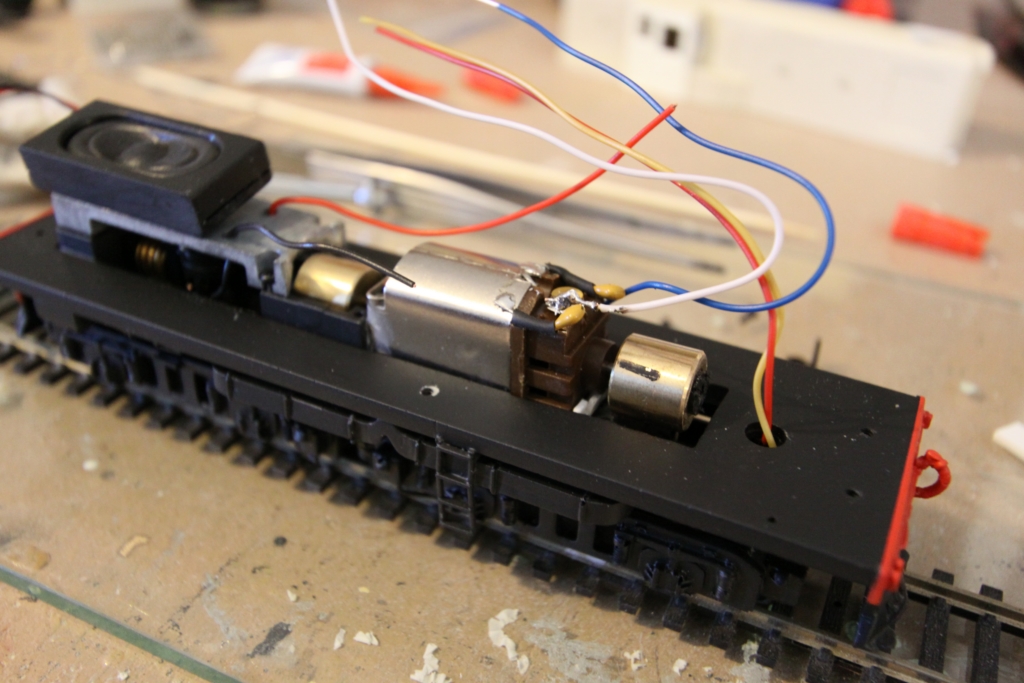
Installing a sound decoder in a Railwest WAGR Y Class Locomotive
Since finishing my WAGR Y class locomotive from Railwest Models, I thought I would upload some pictures showing the modifications I made to fit the motor, the motor mount and lead weight. Its also interesting how I was going to install the sound decoder, showing wiring and position of the speaker....
Hope this is of some help to those still in the construction stage.
The small video clip is the final product, with sound. Its a great little kit!
Saturday, July 14, 2012
The Models of Allen Howe
At the recent July 2012 meeting of the Sn3½ special interest
group of the AMRA WA Branch, the scratch-built models of Allen Howe were shown
to the members. Though he started modelling relatively later in his life, Allen is a very accomplished modeller of the WA 3’6”
system in the period 1940-1972.
Aside from the many WAGR kits which he has assembled, Allen
has built at least eight steam locomotives in brass. Allen has also built four suburban side-door coaches in styrene and brass.during the
period 1990 through 2006, during his retirement and following a long career with
the WAGR. The locomotives include two Pm, two P class, 3 D class locos (a DD,
DM and a D) and an Australian Standard Garrett locomotive. Allan is probably the first to
successfully attempt and complete a scratch-built model of an ASG in S scale. It was a major achievement and not to be tackled by the inexperieced model builder. Allen's ASG ran smoothly and
successfully at several AMRA Model Railway exhibitions before and after 2002. The locomotive had the power and traction to haul very long consists as the prototype was designed to do.
Allen's models show great attention to detail drawing on his long
and vast experience as a tradesman at the Midland Workshops. An article is planned for the Australian SN Modeller
magazine in the near future but in the meantime, the following three photos of Allen’s models
provide a taste of his modelling work.
| Allen's Howe's ASG emerging from Swan View tunnel 2002 |
![]() |
| Four of Allen's suburban coaches on S Mackay's layout |
![]() |
| A fine example of Allen's D class locomotive on Swan View - Bill Gray photo. |
AYB Suburban Brake
In 1945 as part of the WAGR rehabilitation program after WW2, a new set of six suburban cars including 4 AY’s and two AYB’s (#456 – 457) were built. Another set was built in 1946 including 2 AYB’s (458 & 459) and 2 AY cars. The AYB’s were basically an AY with a guards compartment at one end. They were built on steel underframes with matchboard sides and entered service in a larch green, light green & cream livery and able to accommodate 64 passengers, ably supplementing the ageing fleet of sidedoor/dogbox style cars predominantly in use on the suburban network.
The First class section of a suburban train was always at the Fremantle end and so the AYB at that end of the train was considered to be First Class whilst the AYB at the other end was considered to be Second class, despite there being no difference between the AY and AYB cars internally.In October 1951 the WAGR chose to introduce a new standard livery for carriage stock, replacing indian red and two tone green and cream schemes, with an "All Over" larch green. In 1952 AYB's 456 & 457 were outshopped in the new Green livery with 458 & 459 following in 1955, During 1956 another livery of White, Green and red stripe had been applied to the railcars, becoming the standard "Suburban" livery. In 1963 this livery was applied to AYB 459 with 456 & 457 repainted in 1966 & 1967. AYB 458 is thought to have retained Green till as late as 1970 by which time both 456 & 457 had been written off in 1969. Modernisation also took place during the 60's with some of the cars losing their matchboard sides, crown light windows and ornate panel work above the windows, these niceties being replaced with plywood panelling in various stages, which for modelling purposes, requires some research by the modeller.
In 1970's, AYB's 458 & 459 continued into Westrail service with refurbishment and Orange and Blue stripe livery. 1986 saw another refurbishment and a Green and Cream livery which saw them through till January 1991 when they were replaced by electric railcars. These two cars made it to preservation, in use until recently on the Pemberton Tramway.
The above model of AYB 456 has been achieved by kitbashing a WestOzModels "AY" body kit. After some planning and consideration of how to go about it, I set about cutting away sections of the rear compartment area of the AY body sides. Retaining upper and lower panelling, the windows were cut away and the single Guards compartment window was replaced with a window from another scrap AY side. Armed with measurements from the prototype the sides were shortened and new Door and Corner Posts were installed to form the end of the car, followed by panels between the window and doors. A new End was produced along with Guards doors to suit the prototype and then panelling detail was made and applied. I estimate this took about 20 hrs to achieve.
After application of handrails and underfloor detailing the carriage was sprayed - first with a "Holts" grey auto primer and then colours applied (Humbrol & Revell). When the body paint had dried, handrails were picked out in Yellow and Silver, decals were applied and the car was sealed with a spray of Wattyl Matt Estapol. Windows were then applied using "Microscale Crystal Clear". With the windows dry, the last job was to fit bars to the Guards Door windows and carefully paint them in Yellow.
The pictures here, show the prototype model for the AYB Suburban Brake Car “Body” kit which is now available from WestOz Models. This AYB "Body" kit is produced in polyurethane and comes with a aluminum roof. All other parts are available from Railwest Models.
Prototype information complied from “A History of WAGR Passengers Carriages” by A. May and B. Gray
Monday, June 25, 2012
New source for Pliobond
Pliobond has been used for many years for handlaying track and building turnouts, but it is now virtually impossible to get in Australia other than in industrial quantities.
Thanks to eBay, I tracked down a source from the US in small tubes, which are a convenient size for modelling purposes. Here is the eBay link
It is actually a fishing tackle shop and they sell Pliobond for coating knots, etc. The good news is that they are happy to send to Australia and it took about 2 weeks to arrive. I would suggest NOT ordering more than 2-3 tubes in one go as a larger order may attract suspicion from postal authorities as many suppliers will not send glues and paints via airmail.
Each tube is 30 ml, compared the last batch I bought locally which were 50 ml. The smaller tubes are actually an advantage as it does become more viscous after several years once opened.
As well as tracklaying, Pliobond is a useful adhesive for joining dissimilar materials such as wood to styrene, metal to styrene, and wood to metal. It usually is used as a contact adhesive by applying a thin coat to both items, letting it dry a bit, then bringing the items into contact and clamping for a while.
For tracklaying, it is only necessary to coat the underside of the rail (flatbottom only) then let it dry for 15 min or longer. When the rail is positioned on the sleepers (usually wood), heat applied from a soldering iron to the top of the rail softens the dried Pliobond and allows it to stick to the sleepers. The great thing is that minor adjustments to track gauge, etc. can be made anytime later simply by heating with a soldering iron. The rail can be precoated well in advance, and the Pliobond is no longer sticky once dry. Rail precoated with Pliobond lasts indefinitely and can be used any time.
Thanks to eBay, I tracked down a source from the US in small tubes, which are a convenient size for modelling purposes. Here is the eBay link
It is actually a fishing tackle shop and they sell Pliobond for coating knots, etc. The good news is that they are happy to send to Australia and it took about 2 weeks to arrive. I would suggest NOT ordering more than 2-3 tubes in one go as a larger order may attract suspicion from postal authorities as many suppliers will not send glues and paints via airmail.
Each tube is 30 ml, compared the last batch I bought locally which were 50 ml. The smaller tubes are actually an advantage as it does become more viscous after several years once opened.
As well as tracklaying, Pliobond is a useful adhesive for joining dissimilar materials such as wood to styrene, metal to styrene, and wood to metal. It usually is used as a contact adhesive by applying a thin coat to both items, letting it dry a bit, then bringing the items into contact and clamping for a while.
For tracklaying, it is only necessary to coat the underside of the rail (flatbottom only) then let it dry for 15 min or longer. When the rail is positioned on the sleepers (usually wood), heat applied from a soldering iron to the top of the rail softens the dried Pliobond and allows it to stick to the sleepers. The great thing is that minor adjustments to track gauge, etc. can be made anytime later simply by heating with a soldering iron. The rail can be precoated well in advance, and the Pliobond is no longer sticky once dry. Rail precoated with Pliobond lasts indefinitely and can be used any time.
Thursday, June 21, 2012
Parkerville on Show 2012
The recently held 2012 Model Railway Show saw Murray Hartzer's "Parkerville" layout, dusted off and spruced up to show the public what the WAGR S scale group do.
The real Parkerville was one of the first stations to be constructed on the railway line between Bellevue and Mount Helena, opening for traffic in 1898. The Station and the railway was closed on the 13th Feb 1966 as part of a change of route to the more easily graded line through the Avon Valley.
This fine layout showcases the Western Australian countryside found just east of Perth on the old Eastern Railway as it climbed up the Darling Range through John Forrest National Park.
A new feature on the layout this year was the addition of "Hovea" - a halt station located between National Park station and Parkerville easily recognisable by the row of Palm trees lining the back of the platform.
Murray had been wanting to add Hovea for some time and was pleased that he had been able to add this nice feature to his layout this year.
As usual the Western Australian layouts are popular with the crowds and also suitably impressive to the judges too! Murray does a great job of finishing off the scenic look of the model with suitable vehicles and people scenes added to bring the layout to life.
Well done Murray!
Subscribe to:
Posts (Atom)